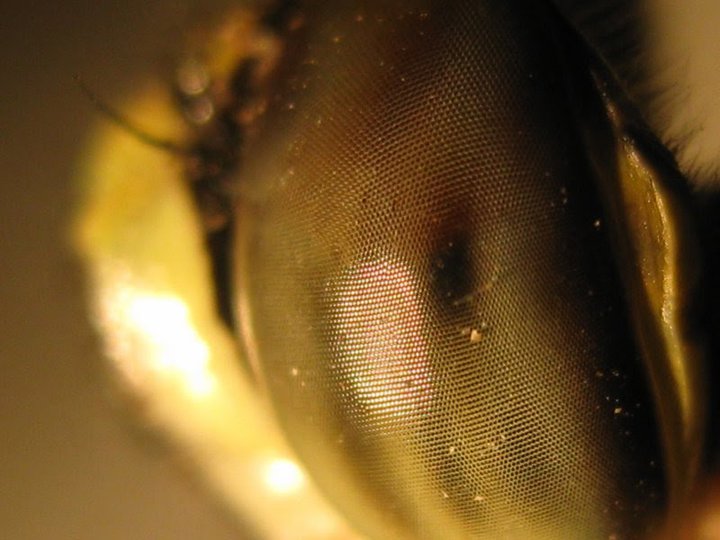
 📷dragonfly-eye.jpg
~0.03 mm
Dragonfly eye facets
Up to about 30,000 tiny lenses packed side by side. Round lenses pressed together become hexagons, so the eye has no blind gaps.
PackingBees build it. Cooling lava cracks into it. A storm on Saturn wider than two Earths spins in it. Why does nature keep choosing the hexagon?
Find out ↓Move your mouse or tap the honeycomb
angle at every corner
less wax than square cells
regular shapes that tile with no gaps
width of the biggest hexagon in nature
Pick one. Most people get it wrong.
Look into a beehive and you'll see six-sided cells packed wall to wall with no gaps. Bees never studied geometry. So how did they end up with the perfect answer?
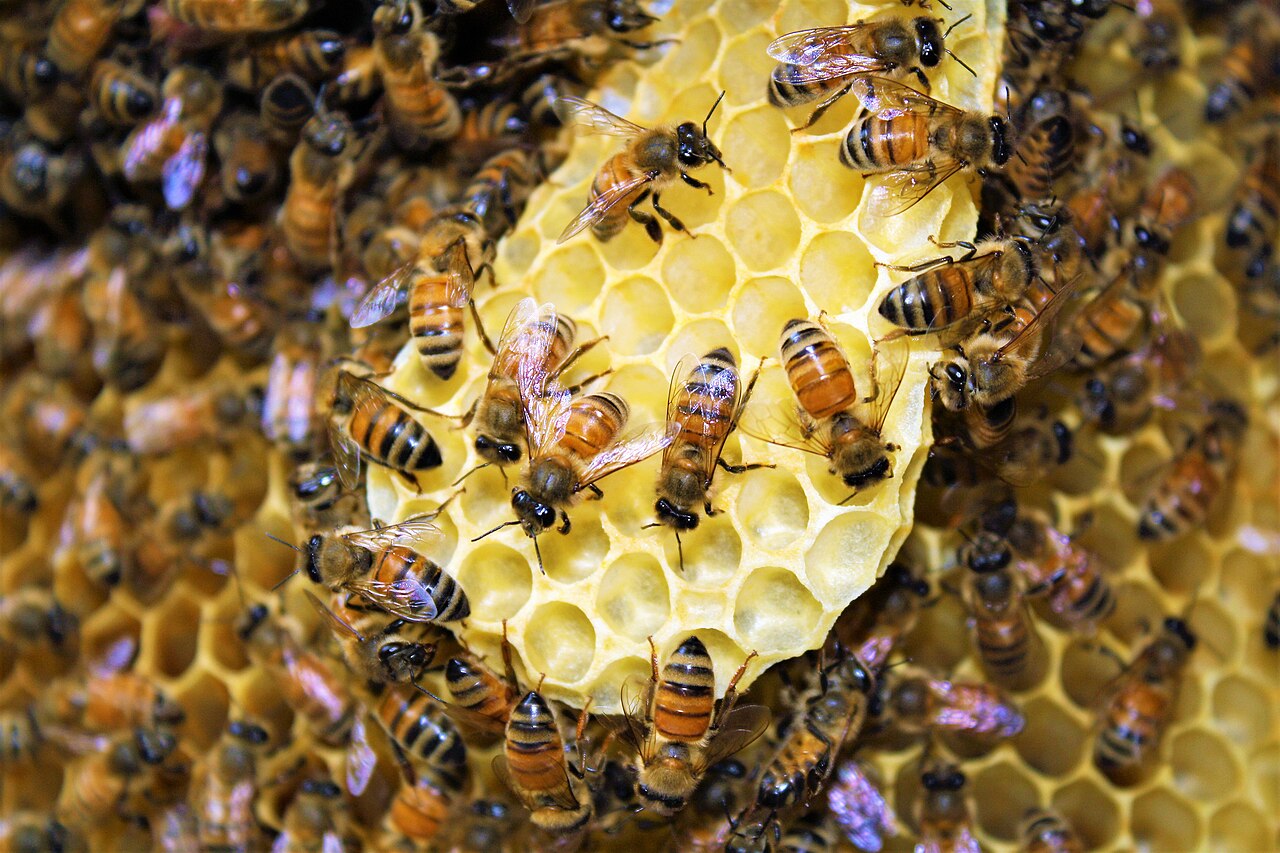 📷 Honeycomb photoimages/honeycomb.jpg
Every cell has six walls, and every wall is shared by two cells, so nothing is wasted. That matters because wax is very expensive for bees: a colony eats roughly 6–8 kg of honey to make 1 kg of wax. So the real question is: which shape holds the most honey for the least wax?
Hexagons show up across more than a trillion times difference in size. Hover over a card to find it on the size ruler (each step is 10× bigger).
📷dragonfly-eye.jpgUp to about 30,000 tiny lenses packed side by side. Round lenses pressed together become hexagons, so the eye has no blind gaps.
Packing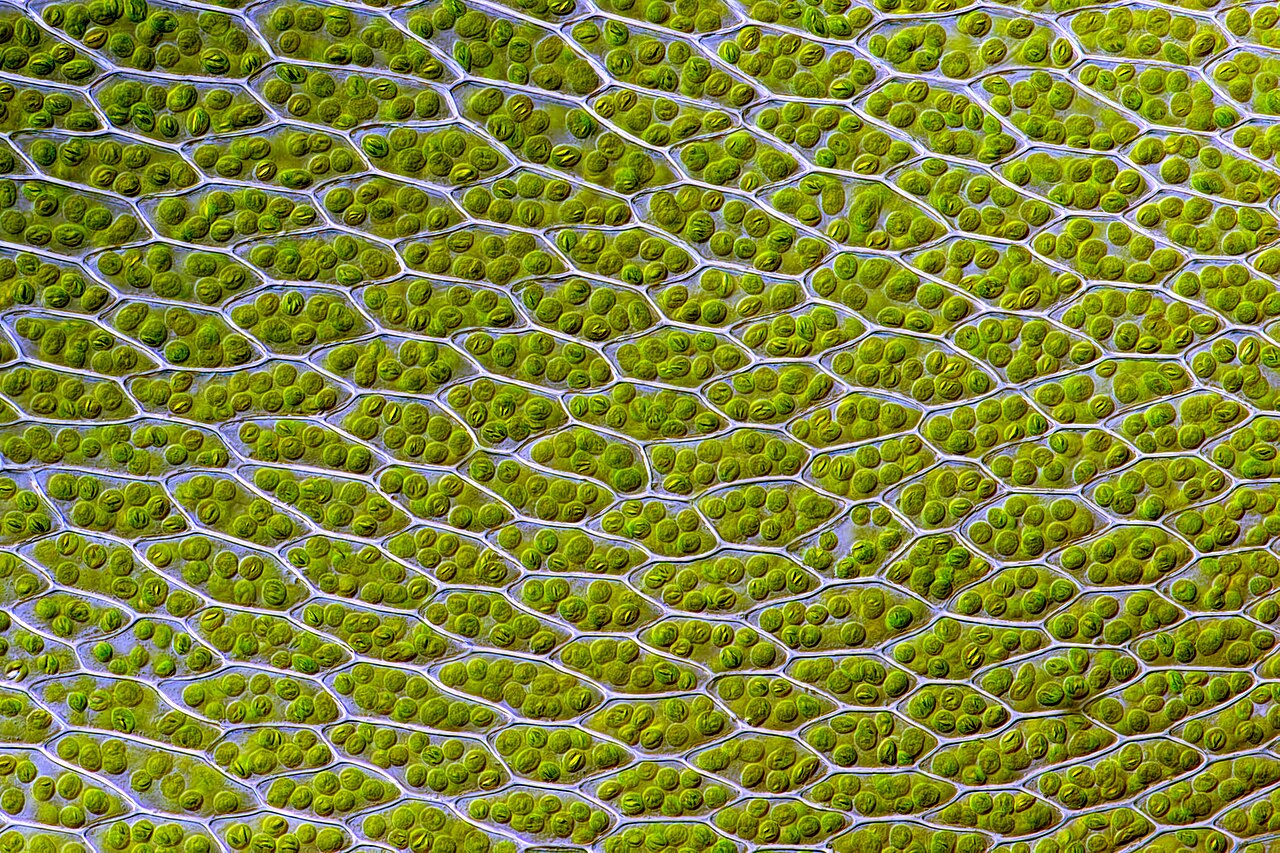 📷plant-cells.jpg
In this moss leaf, almost every cell has six sides. Growing cells push on each other like soap bubbles, so on average each one ends up with about six neighbors.
Pressure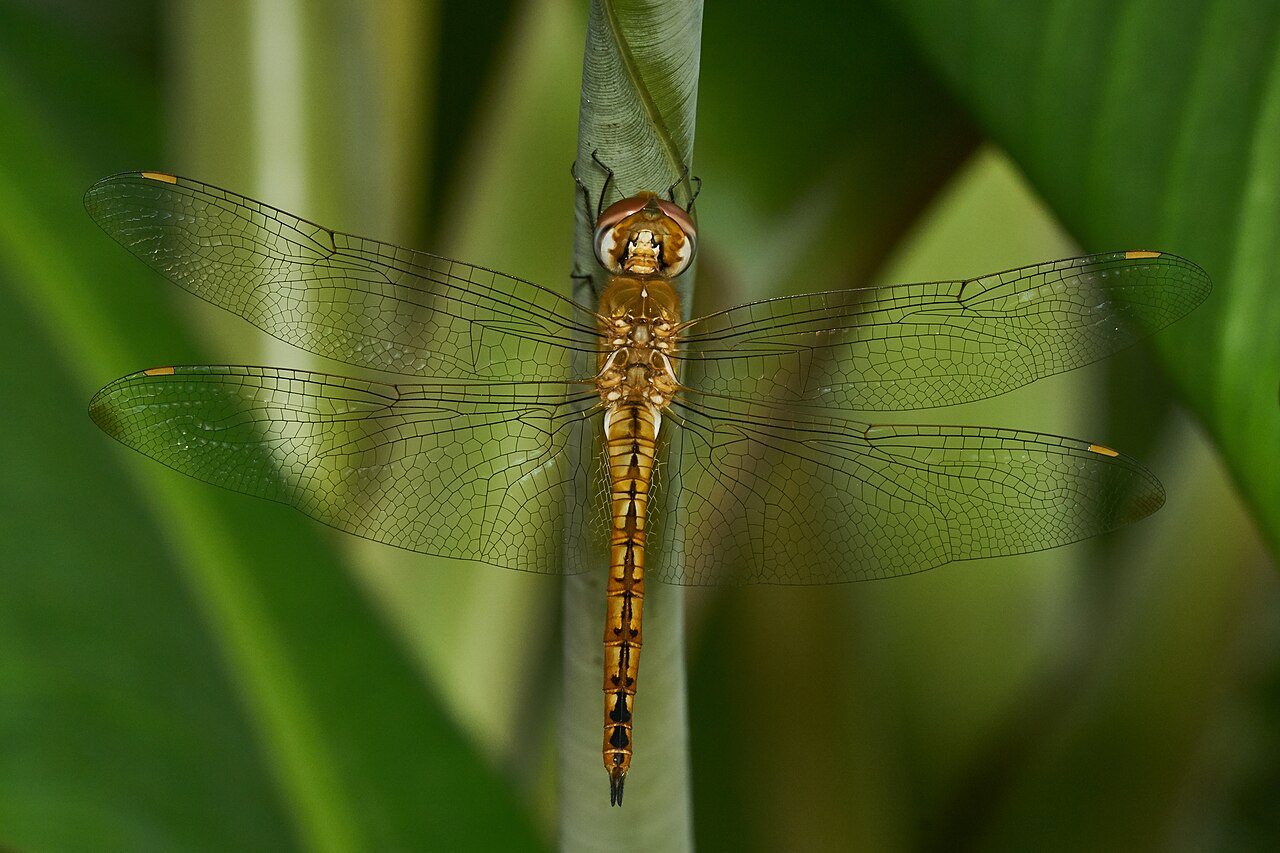 📷dragonfly-wing.jpg
A web of veins forms many polygon cells, lots of them six-sided. The wing stays stiff and strong while weighing almost nothing.
Strength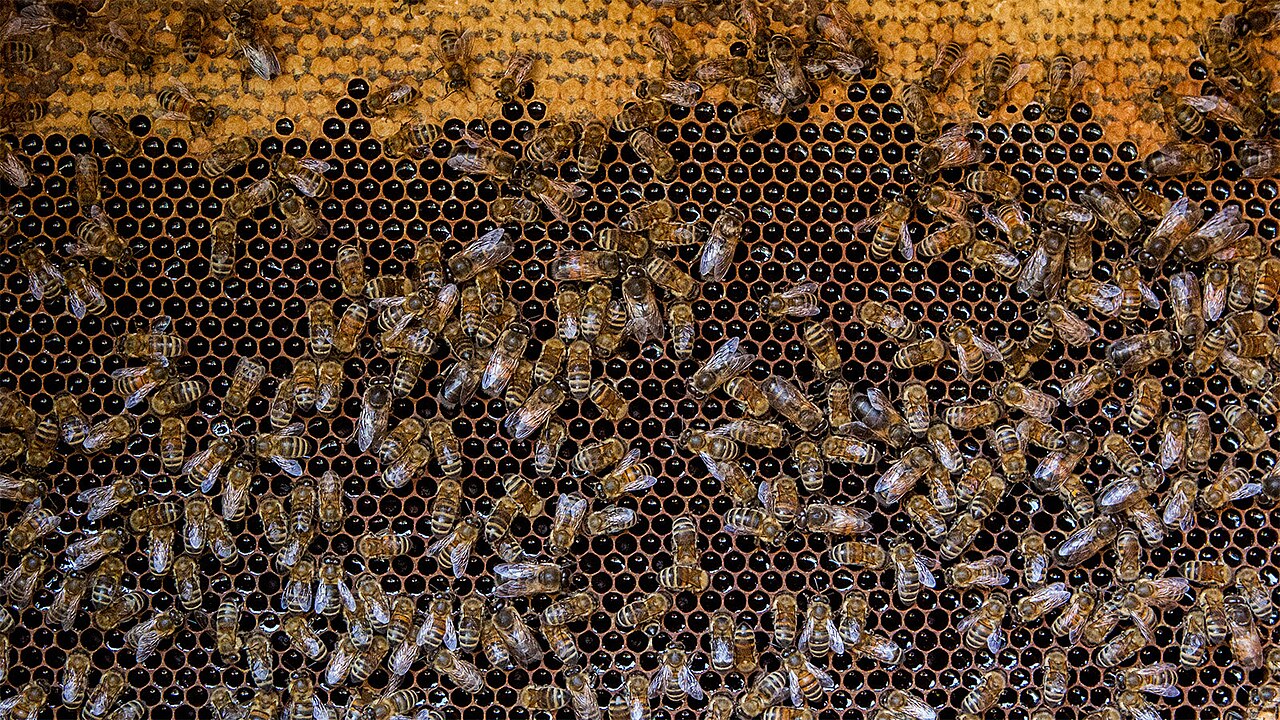 📷honeycomb-cells.jpg
The famous one. The most storage for the least wax, and walls that brace each other in three directions.
Least material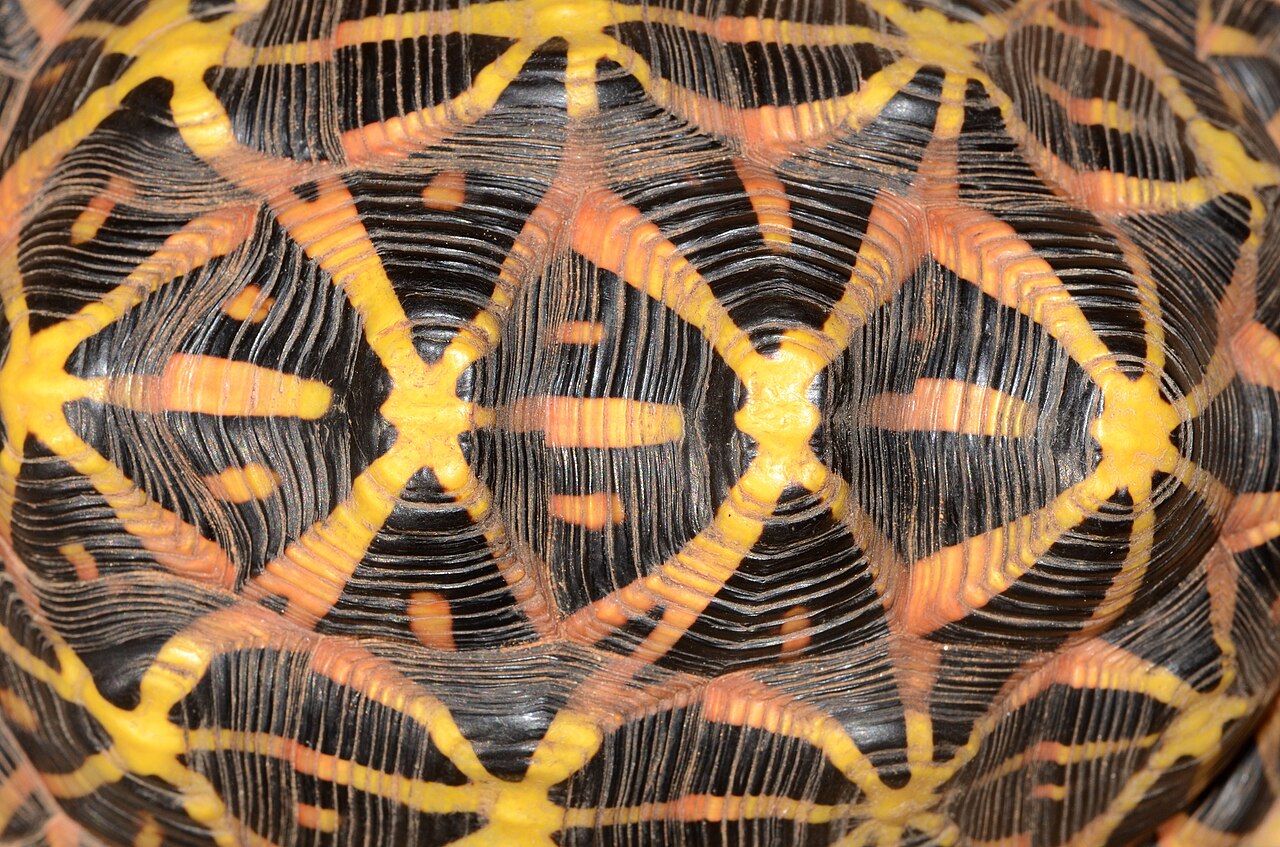 📷turtle-shell.jpg
Many tortoises have six-sided scutes on top of the shell. A tough, tiled armor that keeps growing with the animal.
Growth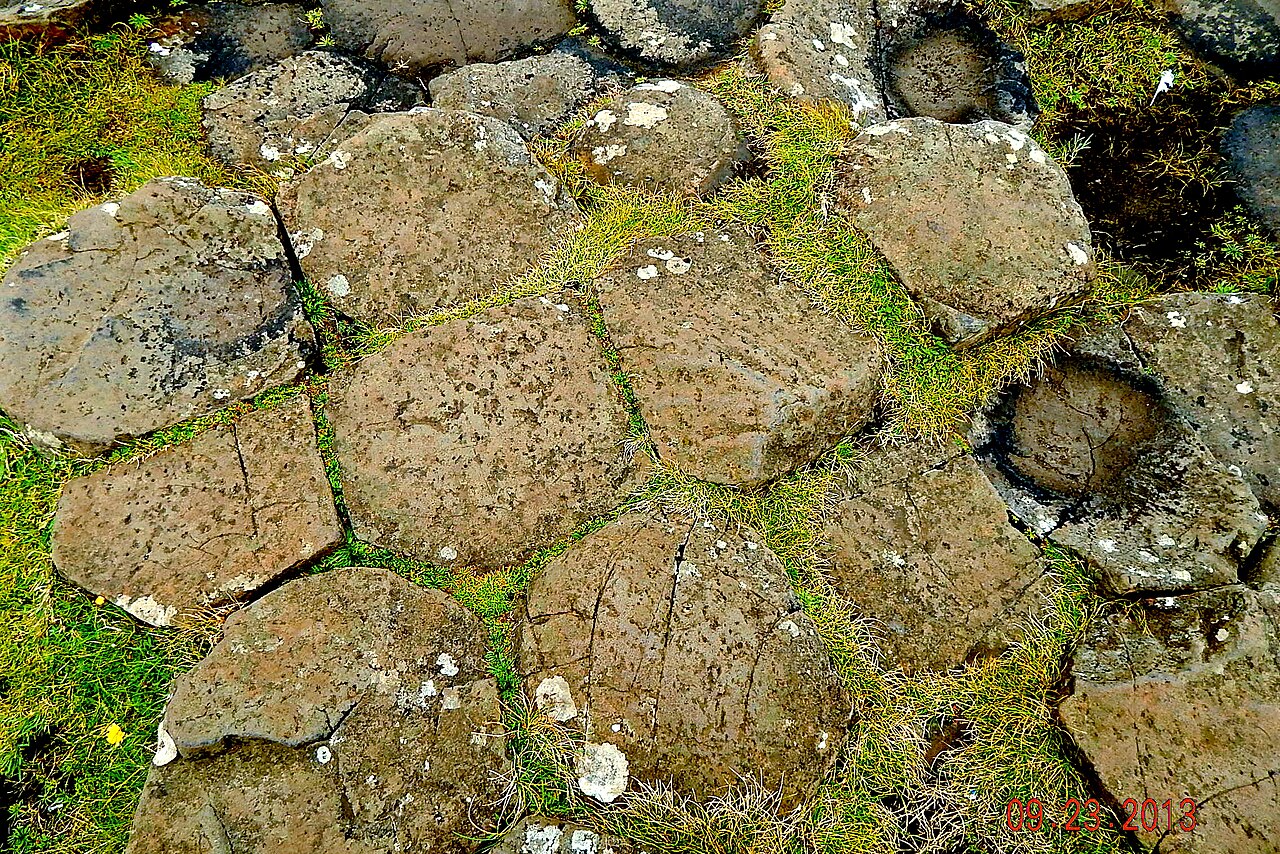 📷basalt.jpg
Thick lava shrinks as it cools and cracks. The cracks release stress best when they meet at about 120°, making columns like the Giant's Causeway.
Least stress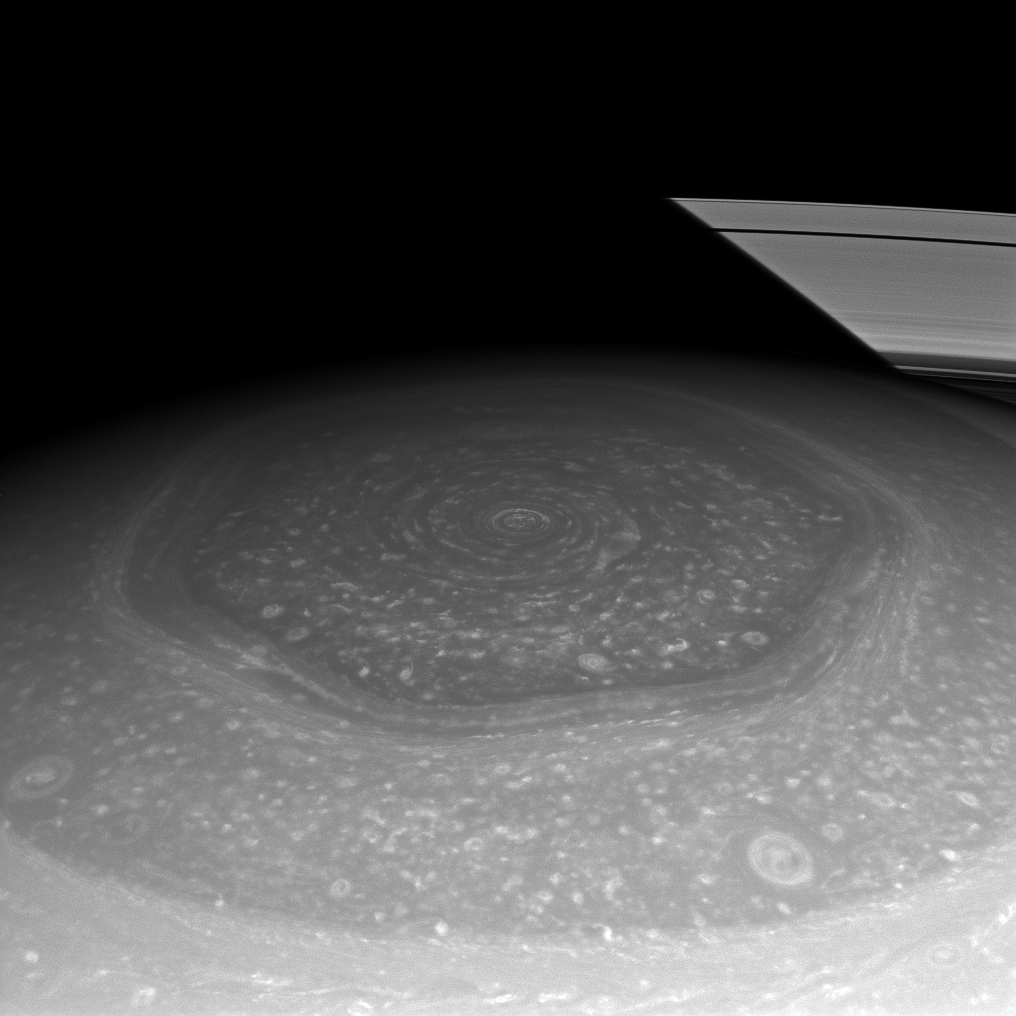 📷saturn-hexagon.jpg
A jet stream shaped like a hexagon, wider than two Earths, photographed by NASA's Cassini probe. No walls, just moving gas.
Fluid flowThe pattern behind the pattern: the causes are different (packing, pressure, cracking, flow), but each one is a system trying to use the least energy or material. Again and again, that lands on the same answer: three walls meeting at 120°. That's a hexagon.
Step 1: no gaps allowed. If identical regular shapes meet at a corner, their angles must add up to exactly 360°. Only three shapes manage it.
Step 2: give every cell the same area (the same amount of honey) and measure the wall around it (the wax). Pick a shape:
Wall length around one cell of area 1 (shorter = less wax)
Set each cell's area to 1 and solve for the side length s:
| Shape | Perimeter | Extra wax vs. hexagon |
|---|---|---|
| Triangle | 4.56 | +22.5% |
| Square | 4.00 | +7.5% |
| Hexagon | 3.72 | winner |
The more sides a shape has, the closer it gets to a circle, the most "round" shape of all. The hexagon is the roundest shape that still tiles with no gaps.
The idea is called the Honeycomb Conjecture: the best way to split a flat surface into equal areas, with the least total wall, is a hexagon grid.
Roman writer Marcus Terentius Varro suggests bees use hexagons to save wax.
1600sKepler studies honeycomb and snowflakes and wonders why nature likes six.
1999Mathematician Thomas Hales finally proves it, even against shapes with curved sides.
Bees had the answer for millions of years. Mathematicians needed about 2,000 to prove it.
Step 3: real cells aren't flat. They're prisms: a hexagon pulled up into 3D. Pick a model and drag it to spin it around.
The 3D models need an internet connection and WebGL. Reload the page while online to see them.
Nature doesn't do math. It pushes, squeezes and relaxes until nothing can get any better. Watch it happen: these cells start random, and each one keeps moving to the center of its own space.
The simulation needs an internet connection to load. Reload the page while online to see it.
At every corner of a honeycomb, three walls meet at 120°. Their pulls balance perfectly, so no wall is stressed more than the others. Soap bubbles follow the same rule (Plateau's laws). If four bubbles meet at one point, it is unstable and splits into two three-way corners.
Each wall belongs to two cells, so every bit of wax works twice. In a full comb a hexagon cell costs only half its perimeter, about 1.86 units of wall per unit of honey, compared with 2.00 for squares and 2.28 for triangles.
In 2013, engineers at Cardiff University filmed bees building cells that start out round and quickly turn hexagonal. They argued that warm, soft wax flows into 120° corners by itself, like soap bubbles. Other researchers argue bees shape the walls on purpose. Scientists still debate it, and it may be a bit of both.
Click or drag to fill cells with honey, or press Swarm to let a colony build from a single cell, the way real bees grow a comb outward. Save your design as an image.
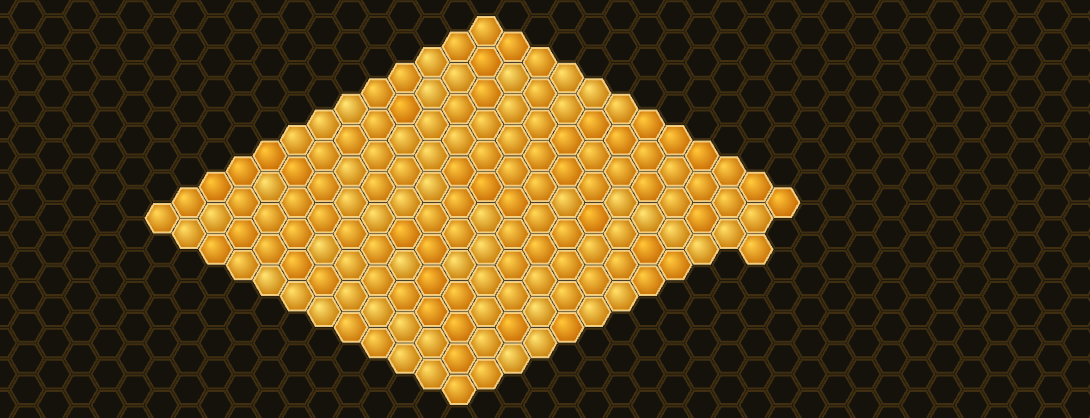 📷 My creationimages/my-creation.jpg
I created an interactive digital tool where users can build their own honeycomb by clicking or dragging to fill cells with honey. The interface demonstrates how hexagons fit together perfectly with no gaps, allowing users to experience the efficiency firsthand. The "Swarm" feature shows how a single cell can grow into a full comb, mimicking how real bees build outward from a starting point.
My tool uses the 120° corner geometry and shared walls that make hexagons efficient. Every cell shares walls with neighbors, and the 120° angles create perfect vertices where three cells meet. Users can see this geometry in action as they fill the honeycomb—no gaps, perfect tessellation.
I chose golden and amber colors to represent real honey and wax. The grid layout emphasizes the mathematical precision of hexagon packing. The drag-to-fill interaction makes the geometry feel tangible. I made sure cells can be filled in any order—the structure adapts perfectly because of the mathematical properties of hexagons.
How would the tool change if we added constraints, like having to fill cells in a specific pattern? What if we showed the perimeter calculation in real-time as users fill cells, so they could see the efficiency improvement? Could this work in 3D with the tilted diamond shapes that real bees use?
Math isn't just answers. This is the path my questions took. (Rewrite each step in your own words.)
I picked natural hexagons because they keep appearing in very different places: beehives, rocks, insect eyes. That seemed too often to be an accident.
2 · AskMy two questions: Why are hexagons more efficient than other shapes? and How do they show up at totally different scales?
3 · TryI calculated the perimeter of a triangle, a square and a hexagon with the same area. My first guess was that the square would win, and it didn't.
4 · SurpriseA circle has an even shorter edge than a hexagon, but it leaves gaps. The best answer is a compromise: the roundest shape that still tiles.
5 · Connect"Least material, most strength" isn't just about bees. Lava, soap bubbles and even a storm on Saturn follow the same rule of saving energy.
6 · NextWhat I still wonder: what happens in 3D? Bees cap their cells with tilted diamond-shaped faces. Is that the most efficient shape too?